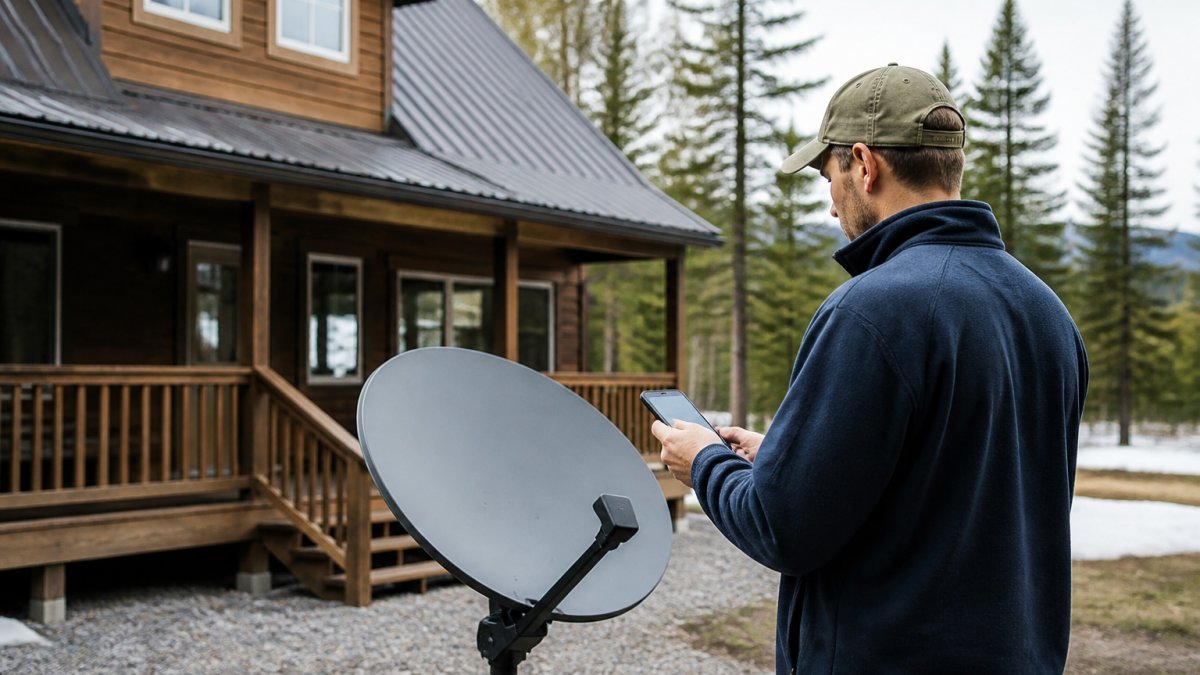
 how-to
7 Steps to Check Satellite Internet Availability by Address
Last Updated: October 26, 2026
Quick Summary
Checking satellite internet availability by address takes several steps: your exact address, the coverage maps, what providers will actually sell at your lot, line of sight to the sky, and the equipment and installation. You don't have to do any of that alone. The REVOLUTION llc assesses every one of these steps for you, for free, as part of our service. All you need to do is reach out by phone call, email or text.
- Have your full street address handy, with directional prefix and suffix, not just a town name.
- Coverage maps show reported coverage only; we confirm what is actually available at your address.
- Address checks return three results: service available, service pending, or no service.
- GSO satellites orbit about 22,236 miles up, producing higher latency than LEO service.
- A professional install gets the dish aiming right the first time, and we plan it with you.
Table of Contents
- Step 1: Share Your Address Details With Us
- Step 2: We Read the Satellite Internet Coverage Maps for You
- Step 3: We Verify Service at Your Address
- Step 4: Starlink Availability by Address: We Check It for You
- Step 5: We Assess What Affects Satellite Internet Availability
- Step 6: We Plan the Hardware, Installation, and Weather
- Step 7: Satellite Internet for RV and Mobile Use
- Talk to the REVOLUTION llc About Your Address
- Frequently Asked Questions
Step 1: Share Your Address Details With Us
Satellite internet availability is not a simple yes-or-no question. It depends on where you live, what you can see in the sky, and which provider covers your area. At the REVOLUTION llc, we help homeowners across West Michigan sort through this every week.
You don't need to open a single website or run any checker yourself. When you call, email or text us, a few details help us give you a fast, accurate answer, because a sloppy address is the fastest way to get a wrong one.
Here is what helps to have ready:
- Full street address, including any directional prefix (N, S, E, W) and suffix (Road, Avenue, Lane)
- ZIP code, since many coverage tools search by ZIP first
- County name, because rural coverage often splits along county lines
- Property type, whether it is a house, cabin, or manufactured home
- Line-of-sight notes, if you know them, such as which direction your roof faces and what trees or buildings block the southern sky. If not, that is one of the concerns we assess for you.
The southern sky matters more than most people realize. Most satellite dishes need a clear view toward the equator. A house buried in a maple grove will struggle, no matter what a map says.
That is why we check your exact address, not just your town. Town-level results can show service where your specific lot has none.
Step 2: We Read the Satellite Internet Coverage Maps for You
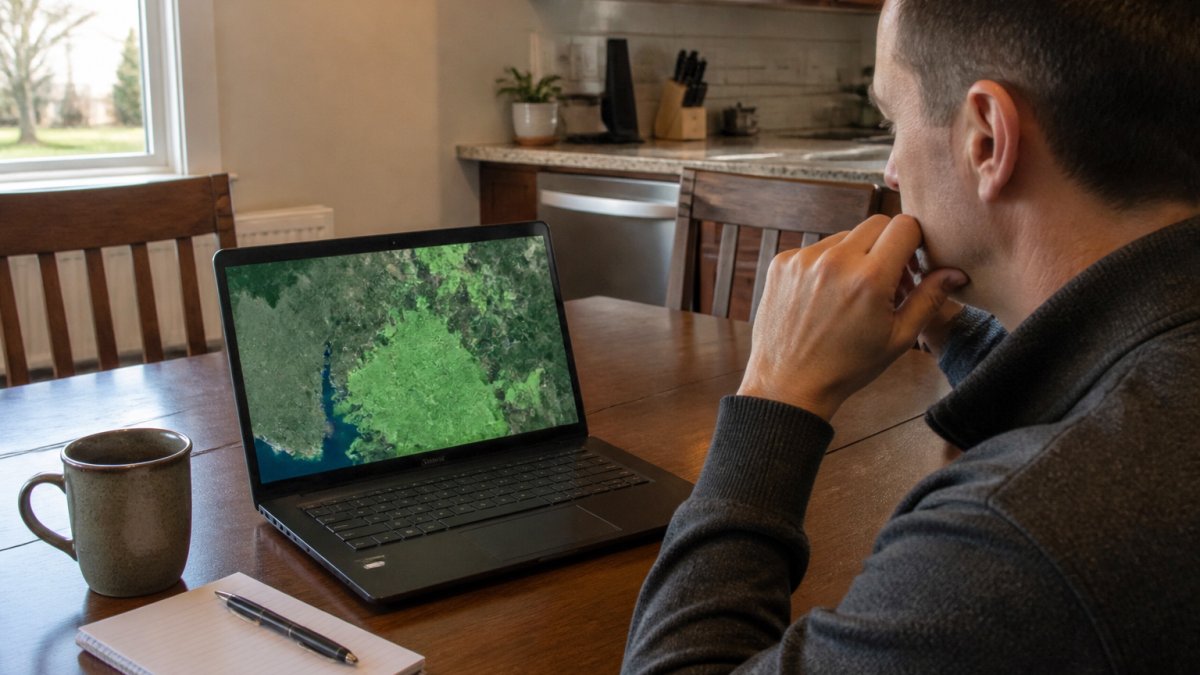
A satellite internet coverage map is a visual tool that shows which areas a provider claims to serve. It is a starting point, not a final answer. The difference between a map that helps you and one that misleads you comes down to knowing who built it, what data it uses, and how stale that data is.
These maps come in two flavors. Provider maps show one company's footprint and are built to sell service. Government maps show broadband service across the whole country and are built to inform policy, from data that providers report a couple of times a year. Both are useful, but neither is the last word on your lot.
You don't have to learn to read them. Reading the maps for your address is part of what the REVOLUTION llc does for you, for free. Here is what we look at so you don't get fooled:
- Street level, not just county level. County-level shading hides the gaps that matter at your lot.
- What "served" really means. On government maps, a location is "served" if a provider reports it can offer service, not if anyone has installed it there.
- Satellite results only, without the cable, fiber, and fixed wireless results that do not apply to you.
- How fresh the data is. Provider-reported data can lag actual buildout by months.
- The reported maximum speed, not just the presence of a provider. Service at your address may still be capped well below what you need.
Maps lag behind reality. A provider may have added capacity last month that the map has not captured yet, or may have stopped accepting new customers in a cell that still shows as served. That is why we treat any map as one data point among several and confirm with a direct address check before you plan around it.
Step 3: We Verify Service at Your Address
Address verification is the step where you move from "probably" to "definitely." Instead of you entering your address into one tool after another, we check satellite internet providers by address for you and tell you the service status.
The result usually falls into one of three buckets:
| Result | What It Means | Next Move |
|---|---|---|
| Service available | Provider offers a plan at your address | We confirm the plan and hardware with you |
| Service pending | Coverage exists but capacity is full | We walk you through the waitlist and other options |
| No service | Address falls outside the footprint | We look at the other options for your address |
A common mistake is stopping at the first "available" result. Availability does not guarantee a good experience. We always ask two more questions for you: what speed can this address actually get, and is there a data cap?
Speed and data cap vary by plan. A plan advertised as high-speed may throttle you after a set amount of monthly use. We read the fine print with you before you commit.
We also go over the installation fee and hardware cost up front, so nothing adds up behind your back.
Step 4: Starlink Availability by Address: We Check It for You
Starlink availability by address works differently from older satellite services. Starlink uses a constellation of low earth orbit satellites, so coverage depends on capacity in your local cell rather than a fixed dish footprint.
You don't need to sign up anywhere to find out. Tell us your address and we check low earth orbit availability along with your other options. The answer is usually one of three: available now, available at a future date, or a waitlist.
A few things we look at for you:
- Urban and suburban cells fill up first, so rural addresses often fare better
- The hardware is sold as a self-install kit, but roof mounting often needs a pro, and we plan the mounting with you
- Speeds shift with weather and network load
Low earth orbit is not the only option. Geosynchronous satellites serve rural areas too, and we compare both for your address. Here is what that comparison looks at.
Step 5: We Assess What Affects Satellite Internet Availability
Two satellites can cover the same address and deliver very different service. The difference comes down to orbit type, physics, and local capacity, and understanding those mechanisms lets you predict what you will actually get before you sign a contract.
GSO vs. LEO is the key distinction. Geosynchronous (GSO) satellites orbit at roughly 22,236 miles above the equator and stay fixed over one spot, so a dish aimed at one can stay pointed at it (GOES Satellite Network). Low earth orbit (LEO) satellites circle much closer, commonly a few hundred miles up, and move quickly across the sky, which is why LEO service uses a phased-array terminal that tracks satellites electronically rather than a fixed dish.
That distance changes latency, the delay before data starts moving. A signal traveling to a GSO satellite and back covers about 44,000 miles round trip, which produces latency high enough to make real-time video calls and gaming feel laggy. LEO latency is far lower because the round trip is a fraction of that distance, which is why LEO handles Zoom, VoIP, and online gaming noticeably better. If your household depends on real-time applications, orbit type matters more than advertised download speed.
Other factors we assess to decide whether satellite internet actually works at your address:
- Line of sight, driven by dish alignment and a clear view toward the satellite. GSO dishes need a clear southern sky; LEO terminals need a wide view of the sky and track satellites across it.
- Weather, since heavy rain, wet snow, and dense cloud can interrupt the signal. This is called rain fade, and it affects every satellite service to some degree. Ku-band and Ka-band signals are absorbed and scattered by precipitation, so a severe storm can drop throughput or cause brief outages.
- Tree cover, which blocks the sky path. A house buried in a maple grove can fail an install even when the map says service is available.
- Network congestion, which rises as more neighbors in the same capacity cell sign up. LEO systems divide coverage into cells, and a full cell can mean slower speeds or a waitlist even where coverage exists.
- Plan limits, including download and upload speed caps and data prioritization thresholds baked into your plan.
Many rural households find that LEO service handles remote work well, while GSO service suits browsing and streaming. We check which orbit types actually serve your address, then match the orbit to how you use the internet rather than to the biggest number on the plan sheet.
Step 6: We Plan the Hardware, Installation, and Weather
Hardware and installation are where budgets quietly blow up. We plan them with you before you sign anything.
What a setup typically needs, and what we plan for you:
- A satellite dish or flat terminal
- A mount, either roof, pole, or eave
- Coaxial or ethernet cabling to your router
- A power source near the mounting point
- A clear line-of-sight path to the sky
Installation options range from a self-install kit to a professional visit. A professional install gets the aiming right the first time, and a misaligned dish is the number one cause of weak signal complaints. We plan the installation for your home and take care of it.
Weather deserves its own line item. Heavy rain, wet snow, and dense cloud can all degrade the signal. This is called rain fade, and it affects every satellite service to some degree. Storms are usually brief, but they do happen.
Privacy is another angle most guides skip. Online address checkers collect your location data, and some demand a phone number before showing results. With us, you don't have to enter your address anywhere: you call, email or text us, and we do the checking.
Step 7: Satellite Internet for RV and Mobile Use
Satellite internet for RV use follows a different set of rules. A mobile setup travels, so the address you check today will not be the address you use next month.
What we verify for mobile service:
- Whether the plan supports roaming or is locked to one address
- Whether the hardware is portable and easy to set up at each stop
- How coverage holds up outside your home region
- Whether there is a separate mobile plan tier
Many RV owners find that a portable terminal plus a mobile-friendly plan works best. Tell us your actual travel route, not just your home address, and we check coverage along it.
Talk to the REVOLUTION llc About Your Address
Every step above is something the REVOLUTION llc does for you, for free, as part of our service. You don't have to check availability, compare options, assess line of sight or plan the equipment and installation yourself. All you need to do is reach out by phone call, email or text.
The REVOLUTION llc serves West Michigan with satellite television, high-speed internet, and smart home solutions. We confirm service at your address, plan the install, and keep everything running.
Here is what you get when you work with us:
- Expert support across the area, from first check to final setup
- Smart home integration, so your devices finally talk to each other
- Reliable connectivity built for rural homes and home offices
Call, email or text the REVOLUTION llc today, and we will check your address for free and turn it into a connected home.
Frequently Asked Questions
How do I check whether satellite internet is available at my address?
The easiest way is to let the REVOLUTION llc check it for you, for free. Call, email or text us your full street address, including the ZIP code. We match your location against the coverage maps and what providers actually offer at your lot, compare the options, because satellite internet availability varies by provider and by beam footprint, and confirm line of sight and installation options for your specific property.
Can I get Starlink at my address?
Starlink availability by address depends on whether your location falls inside an active service cell with room for new customers. Rural addresses often qualify before suburban ones. Even when service is offered, you still need a clear view of the sky for the dish. Call, email or text the REVOLUTION llc and we check your address, the view of the sky and the mounting options for you, for free.
Does satellite internet work in rural areas?
Yes. Satellite internet is built for places where cable and fiber do not reach, so rural addresses are usually the best fit. Availability depends on the provider's coverage map and whether your property has an unobstructed view of the southern sky for a geostationary dish, or a wide view for a low earth orbit terminal. Speeds and latency vary by technology, and weather can affect signal strength. We compare the plans and plan the installation with you before you commit.
How do I check whether satellite internet is available for an RV?
Satellite internet for RV use works differently from a home installation because your location changes. Coverage needs checking for each place you plan to stay rather than a single address, along with whether a mobile or roaming plan is offered. Portable terminals need a clear view of the sky at every stop, and service may be paused or limited in some areas. Tell us your route and we check coverage, data caps and mobile plans for you before you travel.
